
Network outages caused by a single change reaching production are a familiar reality for telecom operators. Optus, Telstra, Vodafone UK, and O2 have all experienced major outages linked to changes made in their networks in the past three years.
That is exactly what makes the next question so pressing. If a single unverified change can take down a network, what happens when we allow AI agents to autonomously make such changes? That was the question at the heart of the 2nd Network Automation & Innovation Summit (NAIS), hosted by Inmanta on September 16th at the Faculty Club in Leuven.
This year, the event nearly doubled in size, with 80 registrations from 28 companies. Network operators, technology providers, analysts, and industry experts came together for a full day of presentations, discussion, and debate around what it will take to move from increasingly automated networks to genuinely autonomous operations.
From automation to autonomy
Inmanta CEO and co-founder Stefan Walraven opened the day by putting the challenge simply: “AI already reads your network. But it is not allowed to change it yet.”
To illustrate the harder problem, he offered an example: an AI agent evaluates 200 possible network changes and recommends 3. The obvious question is whether those 3 are right. Stefan argued that's the wrong question. The one that matters is: "Why did it reject the other 197?"
AI systems have become very good at generating recommendations. The harder part is knowing whether those recommendations are based on an accurate view of the network, whether they can be trusted, and what happens when an AI system is allowed to act.
His answer was to give AI a safe place to act before it touches production. An intent-based orchestrator, with its service model and automated tests, turns the lab into a playground where AI agents can optimize configurations, chase down QoS root causes, and iterate on their own. The orchestrator acts as the guardrail: what comes out is a validated proposal that human experts review before anything reaches the live network. Open interfaces like MCP make this practical across vendors. At DTW 2026, the TM Forum Catalyst project, ALE-X, integrated four companies that had never worked together in just two days.
Three keynote speakers took that question further.
Francis Haysom of Appledore Research, author of a new digital twin whitepaper developed with VIAVI and Inmanta, argued that a digital twin is more than a visualization tool. It provides the environment needed to test and validate what happens before changes reach the live network, and to make decisions based on a risk assessment.
Xavier Gondry, Head of Transport at Proximus Global(BICS), challenged the idea that full automation is something an operator can simply buy. It isn't. But when implemented properly, he showed how automation delivered his team 70% OPEX avoidance, a 98% reduction in rollout time, and a 60% improvement in quality and reliability.
Stijn Lefebure, Director Networks & Capital Allocation Transformation at Liberty Global, brought the discussion back to a scenario that will be familiar to any operator: It’s 23:40, a service quietly degrading, and an automated system that has already run “a successful command” while leaving “an uncertain service” behind.
His vision for where this needs to end up by 2030 was straightforward: “Networks run. Humans remain responsible.”
Different perspectives, same challenges
The partner sessions brought different perspectives to the same underlying challenge. Celfocus, FNT Software, Tieto, and VIAVI each approached the question from a different angle, but the presentations kept coming back to some of the same practical issues: network data, validation, reliability, trust, and how much control operators are actually ready to hand over to automated systems.
João Antunes of Celfocus shared new TM Forum survey data showing that 25% of operators expect to reach Autonomy Level 4 by 2027, rising to 81% by 2030. Across the sessions, one issue kept coming up: those ambitions depend on having a shared and trustworthy view of what is happening in the network.
Per Kangru of VIAVI made the digital twin case concrete: “The digital twin is not a modelling exercise. It is the trust layer that lets an operator hand control to AI.”
Daria Batrakova of FNT Software put that trust to the test in her presentation, asking an AI agent about the status of a single network port and getting four contradictory answers in a row. Her conclusion was hard to argue with: “At scale, automation doesn't fix bad data. It amplifies it.”
Mats Eriksson of Tieto took the conversation in a different direction, looking at what happens when confidence in AI starts to decline. He shared Uptime Institute's 2026 survey data showing that operator trust in AI to reduce human error had dropped from 51% to 40% year over year, while trust in AI to reduce equipment failure fell from 39% to 34%.
His answer wasn't to step back from AI, but to add a second layer: AI validating AI before a decision reaches production.
Different as the presentations were, they all pointed back to the same requirement: autonomy needs a reliable operational foundation. AI can make decisions, but those decisions still need to be grounded in accurate network state, validated before execution, and observable once they reach production.
More than the sessions
Some of the most useful conversations happened between the sessions: operators comparing what is working, where they are still struggling, and how different approaches to automation are evolving.
Those conversations were a reminder that there is no single path to autonomy. Operators are at different stages, dealing with different networks, systems, vendors, and business priorities. Sharing what works and being open about what doesn't, matters just as much as discussing the end goal.
That mix of practical experience and open discussion is what NAIS is trying to create. It isn't a conference about predicting what autonomous networks might look like someday. It is a place for the people working at different stages throughout this journey to compare what is working, what isn't, and what still needs to change.
A community that keeps growing
The summit's partner base grew too. Where last year's debut brought together four sponsors, this year six companies backed the event: Celfocus, Ductus, FNT Software, Fortinet, Tieto, and VIAVI Solutions.
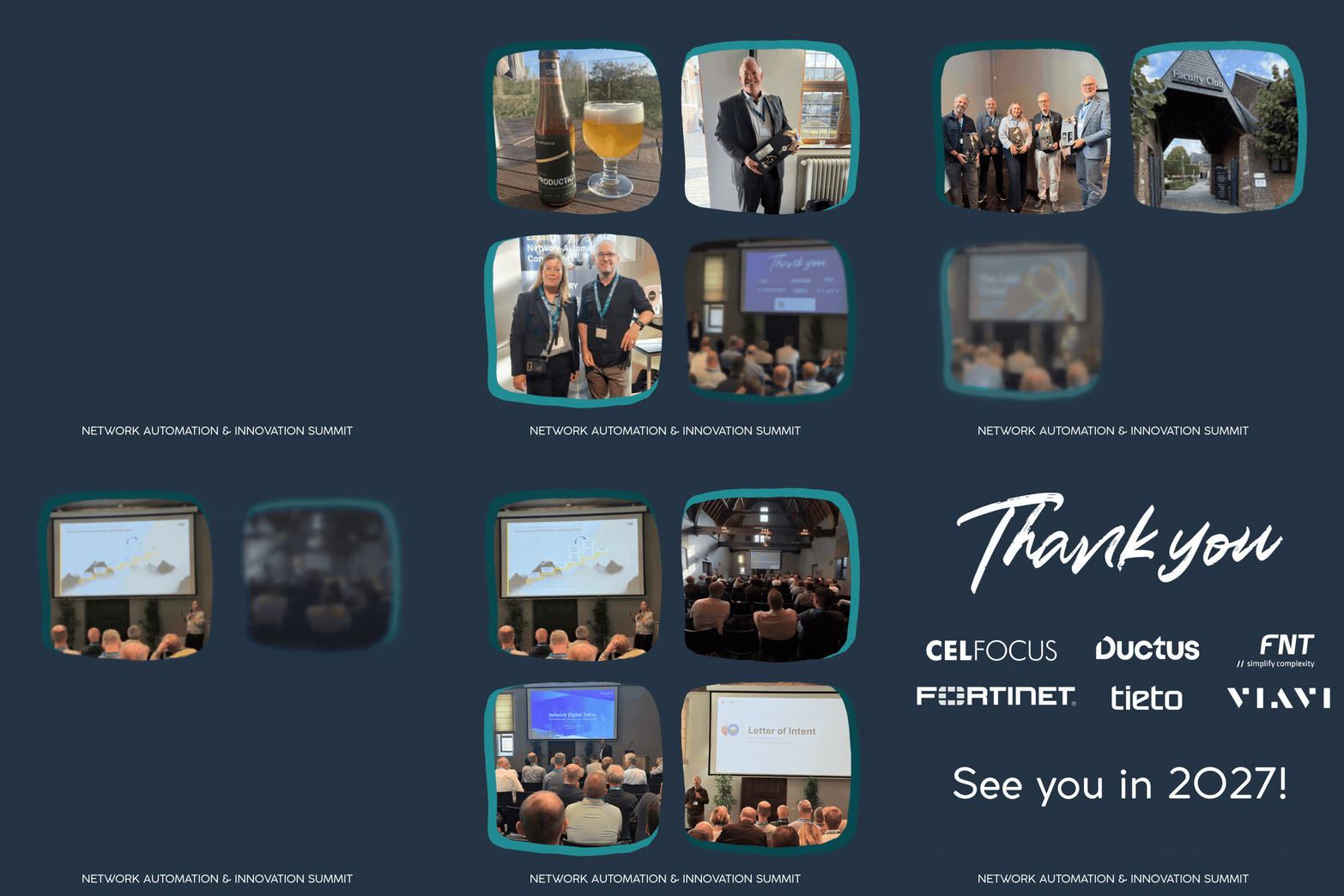
That expansion brought more perspectives into the room without losing what made the first edition work: at its core, NAIS is still a community event. The agenda left plenty of room for coffee breaks, a shared lunch, and drinks and dinner to close out the day. People spent as much time comparing experiences, making new connections, and continuing conversations in the hallway as they did in their seats.
Three takeaways
First, the question is changing.
The industry is spending less time asking whether AI belongs in network operations and more time asking what needs to be true before AI can safely act. A shared, trustworthy model of the network, the “network truth” that came up repeatedly throughout the day, is becoming a prerequisite for autonomy.
Second, trust isn't given.
It has to be built, tested, and maintained. This year's Uptime Institute figures also showed that confidence in AI can move in the other direction when operators don't have enough visibility into what these systems are doing.
Third, autonomy needs somewhere to test itself.
Digital twins came up repeatedly, from keynote presentations to partner sessions. The reason is straightforward: before handing over control of a live network, operators need a way to understand and validate what an automated system is going to do.
See you in 2027
Ultimately, that is what the Network Automation and Innovation Summit is about: bringing the people working through these problems together and creating space for conversations that don't always happen at larger industry events.
Want to be part of the 2027 conversation? Sign up here to be the first to know when registration opens.